By Rich Harvey, CEO & Founder, propertybuyer.com.au
The 2026 Federal Budget handed investors a decision, not a gift.
Brand new property now sits in a genuinely favourable tax position: negative gearing retained in full against your salary, and a choice at sale between the old 50% CGT discount or the new inflation indexation method, whichever produces the lower tax bill. For investors who spent months anxious about what the budget might do to their strategy, that sounds like a clear runway.
In some cases, it is.
But if the last three decades of property investment have taught me anything, it is that the moment a tax concession becomes the headline story, a lot of investors stop asking the questions that actually determine whether they will build wealth. They start asking which property qualifies, instead of which property performs.
Those are very different questions. Confusing one for the other tends to be expensive.
This article walks through what matters most under the new rules. The position I am going to argue runs against the marketing campaigns you will see over the next 18 months. Established property remains a fundamentally strong option for most investors. Brand new property can absolutely work, but only in specific, well-defined situations. The decision should be driven by the asset, not the tax treatment. And the numbers, modelled properly, are decisive.
What the Government is trying to do (and why it will not fully work)
The policy intent here is not irrational. Australia genuinely lacks housing supply, particularly in the middle-ring and inner-ring suburbs where demand is structural and persistent. The government wants private capital flowing toward new construction rather than investors and first home buyers fighting over the same pool of established stock.
A reasonable goal. The execution, though, creates a problem.
Most of the new supply that will actually be built in response to this incentive will not be delivered in the locations where housing supply pressure is most acute. Developers build where land is available and margins are workable. That means outer greenfield estates in the growth corridors well beyond the established middle ring of every capital city, high-density CBD-adjacent towers, and large infill apartment blocks in already well-supplied precincts.
The suburbs where the undersupply actually bites, the established middle rings with constrained land, good schools, strong transport and deep owner-occupier demand, will not suddenly produce a wave of tax-concession-eligible stock. They never do.
So the policy may stimulate construction without solving the problem it is aimed at. That is a familiar pattern. It is worth understanding before you decide where to put your money.
The fundamental test every investor should apply first
Before we talk about which property types might make sense, there is one question worth asking about any purchase you are considering right now.
If the tax concession disappeared tomorrow, would you still want this property?
Would the location carry it? Would the rental demand hold? Would the capital growth case still stack up? Would the pool of buyers who might purchase it from you in ten years be deep enough to drive genuine competition at sale?
If the honest answer is no, the concession is doing too much of the work. Tax policy, unlike a well-located property, is subject to change.
This is not an argument against using the available concessions. It is an argument for making sure the asset earns its place independent of them, so the concessions become an upside rather than the entire justification.
Where the risk concentrates in the current market
I am not going to tell you to avoid all new builds. That is too blunt an instrument, and frankly it is wrong. We help clients buy new builds where the fundamentals stack up, and I will come to that shortly.
What I will tell you is where the risk concentrates, based on what we see across the markets we operate in every day.
Outer greenfield estates
House and land packages on the urban fringe will be the most heavily promoted investment product over the next 12 to 18 months. The marketing will be polished. The tax story will be front and centre. The rental yield will look reasonable on paper.
The problem is structural. These estates are built on abundant land, and the supply pipeline runs for years. Scarcity is the engine of capital growth in residential property, and these locations are its structural opposite.
Every time you think about selling, you are competing with the developer’s next stage, the neighbour’s identical floorplan, and every other investor who bought at the same time under the same pitch. Blocks are typically small, often well under 350 square metres, which constrains land value over time. Distance from employment centres limits both tenant quality and long-term price growth. Schools, transport and amenity are usually years behind the housing.
The CGT concession does not manufacture scarcity. It just softens the loss on the way out.
High-density off-the-plan apartments in oversupplied precincts
This is the category where we have seen the greatest concentration of investor disappointment over the long term. I expect that pattern to continue.
The risk is not unique to any one city. It shows up wherever large volumes of investor-targeted stock are released into a precinct that already has more supply than owner-occupier demand can absorb.
When you eventually come to sell, you are selling into a market of other investors, who will price your property on yield, not on aspiration or lifestyle. Body corporate fees erode cash flow more than most buyers model at purchase. New supply in the building next door competes directly with your rental and your eventual sale price.
There is also a pricing reality worth understanding. Developers price new stock to recover land, construction, marketing, GST, margin and increasingly, the tax premium that buyers are willing to pay under concessional settings. That premium is built into the purchase price before you sign the contract. You could be starting day one above what the open market would sustain for comparable stock, in exchange for a tax benefit that does not transfer to the next owner when you sell.
The tax concession on entry does not change the supply dynamics that determine your exit price.
Where new builds genuinely do make sense
I want to be direct here, because the argument is not “new builds are always wrong.” That is lazy thinking, and it would talk our clients out of some genuinely good purchases.
There are situations where new builds work, and we help clients identify them and acquire them. The key is recognising the credible exceptions and separating them from the marketing-driven majority.
Urban infill townhouses in established, high-amenity suburbs
A well-located townhouse in a fully developed inner or middle-ring suburb, with real land content, genuine scarcity in the immediate area, and a surrounding neighbourhood that attracts owner-occupiers as strongly as investors, is a fundamentally different proposition from a greenfield house and land package or a high-rise apartment in a supply-dense precinct.
These properties sit in suburbs where demand is structural rather than policy-driven. Their buyer pool at resale includes families, downsizers and professionals who want the suburb, not just the property. That breadth of demand matters enormously for your exit.
Boutique developments in genuinely supply-constrained markets
We also look closely at markets where dwelling approvals are running well behind population growth and migration pressure, and where new stock entering a constrained market is absorbed quickly without leaving oversupply in its wake. Selected pockets of Brisbane, Adelaide, Melbourne, Sydney and Perth currently fit that pattern. In those environments, a new build in the right location can carry its investment case comfortably, with the favourable tax treatment as a genuine secondary benefit.
Subdivision and development plays
For investors with the appetite and capital, developing new stock on land you already control captures both the developer margin and the new-build tax treatment for the end buyer, which supports your sale price. This is a separate strategy from buying off-the-plan, and one our development team handles end-to-end.
The discipline is identifying which environment you are actually buying into, not which one the marketing brochure describes.
The numbers: a worked comparison
Let me put hard numbers around the argument.
Two properties, same purchase price, same hold period. One is a brand new off-the-plan two-bedroom apartment in a master-planned precinct, growing at 5% per annum. The other is an established three-bedroom property in a high-amenity middle-ring suburb, growing at 7.5% per annum. The new build keeps the 50% CGT discount under the post-July 2027 rules. The established property uses the new indexation method, with the cost base grown by 3% CPI. Both are held for ten years and taxed at a 37% marginal rate.
|
|
New build apartment |
Established house |
|
Purchase price |
$1,000,000 |
$1,000,000 |
|
Capital growth (per annum) |
5.0% |
7.5% |
|
Value at sale (Year 10) |
$1,630,000 |
$2,060,000 |
|
Nominal capital gain |
$630,000 |
$1,060,000 |
|
CGT method |
50% discount |
Indexation (3% CPI) |
|
Indexed cost base |
n/a |
$1,345,000 |
|
Taxable gain |
$315,000 |
$715,000 |
|
CGT at 37% marginal rate |
($116,346) |
($265,333) |
|
After-tax proceeds |
$1,515,000 |
$1,795,000 |
|
Extra wealth from the right asset |
|
+$280,000 |
The established property delivers approximately $280,000 more in after-tax wealth over ten years, even after paying CGT under the new indexation method and even after the new build retains the more favourable 50% discount. The reason is simple: a 2.5% growth advantage, compounded over a decade, produces a value gap that no realistic tax saving closes.
A note on marginal tax rate. At 47% (top marginal rate plus Medicare levy), the after-tax gap narrows slightly to around $245,000, but the established property still wins comfortably. The growth differential does the heavy lifting at every reasonable tax rate. Higher-income clients should not assume a higher marginal rate reverses the result. It does not.
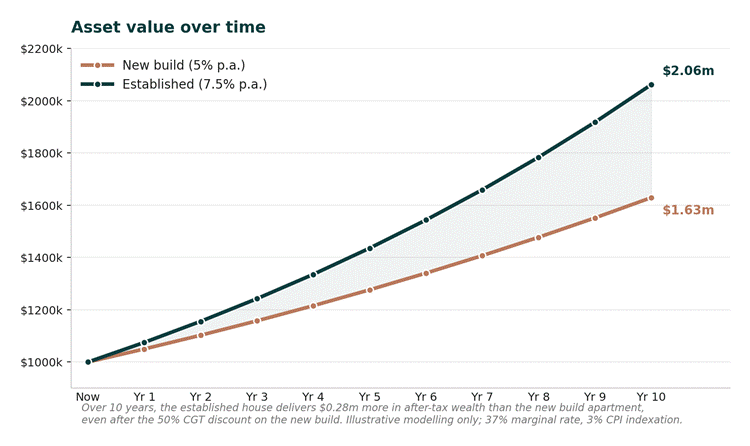
Figure 1. Asset value over time. Same $1m purchase, ten-year hold. The gap widens with every passing year.
Why growth matters 3.6x more than the tax change
The Budget changes shift outcomes by a meaningful but contained amount. The growth rate of the underlying property is what determines whether you build real wealth.
Running the same $1m purchase across a range of growth rates over 20 years, the picture is unambiguous:
- The new tax rules cost an established investor approximately $140,000 over 20 years on a $1m property at 6% growth. That is around 8% of after-tax profit. Painful, but not decisive.
- Just 1% higher annual growth on a brand-new property over the same 20 years adds approximately $507,000 in after-tax wealth.
- Your principal place of residence. Completely untouched. No CGT when you sell, ever. The 6-year absence rule also remains, so you can buy as your home, then rent it for up to six years while keeping the main residence exemption.
- Commercial property. Negative gearing rules unchanged. Yields are typically 5 to 7% plus, versus 3 to 4% for residential. Larger capital outlay and longer vacancy risk, but the income upside is meaningful.
- Super and SMSFs. Not affected by these changes. SMSFs keep the existing 33% CGT discount and full negative gearing.
Growth has 3.6 times the impact of the tax change.
The maths is simple. New tax rules impact: $140,000. Growth rate impact: $507,000. $507,000 ÷ $140,000 = 3.6x.
3.6x applies to brand new property. The equivalent multiplier for established property under the new rules is 2.5x.
This is the central point that gets lost in the post-Budget noise. If you let the tax treatment drive your choice into a 5% growth asset when a 7% growth asset was available, the lost upside is much bigger than the tax saving you went chasing.
What did not change
Three categories of investing are entirely unaffected by the new rules. They remain part of a balanced strategy and deserve a mention:
If your strategy already leans into any of these, the Budget has nothing to say to you.
What this means for your investment decision
Bringing it together, here are the five points that should shape your thinking under the new rules.
- Established property remains fundamentally strong. Lower future tax efficiency at sale, yes. But the growth advantage and the depth of buyer pool at resale outweigh that comfortably for well-selected stock.
- Brand new can also work, in specific cases. Urban infill townhouses in high-amenity suburbs, boutique developments in genuinely supply-constrained markets, and your own development plays. These are credible exceptions, and we help clients identify and acquire them.
- Propertybuyer does both. Established or brand new, residential or commercial, owner-occupier or investor, Sydney, Melbourne, Brisbane or any other capital city. Our recommendation is asset-led, not tax-led, and never tied to a developer relationship.
- Do not buy on the basis of tax deductions alone. Tax is a second or third order priority. The first order question is whether the asset itself will perform.
- Do your numbers. Properly model the after-tax outcome over your actual hold period, with realistic growth, yield and holding cost assumptions. The maths is what closes the argument, not the marketing.
The investors who will look back on this period well are not the ones who moved fastest. They are the ones who stayed anchored to the fundamentals while everyone around them was dazzled by the tax story.
Market fundamentals of undersupply in the right pockets have not changed. Location relative to employment, transport, education and amenity. Scarcity of land and constrained future supply. A broad, deep pool of owner-occupier buyers who will compete for your property when you eventually sell. Genuine land content that appreciates rather than a building that depreciates.
The suburbs that have driven the most consistent long-term wealth creation in Australian property are the ones that were genuinely hard to buy into, because owner-occupiers wanted them just as much as investors did. The Budget has not rewired that dynamic.
Buy the right asset. Let the tax outcome follow.
About Propertybuyer. We have completed more than 5,500 purchases since 2001 across residential, commercial and prestige markets nationally. We operate independently, with no developer relationships and no volume incentives. If you want an honest assessment of a property you are considering, or want to understand what a well-located asset looks like in your target market, call us on 1300 655 615 or visit propertybuyer.com.au
Modelling is illustrative only and based on Federal Budget 2026-27 announcements (subject to legislation). This is not personal financial or taxation advice. Speak to a qualified adviser about your specific circumstances.
Give us a call on 1300 655 615 to start a conversation about your next property purchase, or click here to send us your enquiry today.
To have one of our friendly Buyers' Advocate's contact you, click here to:
 or
or
call us on 1300 655 615 today.



.svg)
.svg)
.svg)