By Guest Blogger, Pete Wargent,
Next Level Wealth
Each month, the Westpac–Melbourne Institute brings out Australia's consumer confidence index results which surveys a broad range of consumers on their feelings about the economy and how confident they are to make consumption and buying decisions.
What are the most recent results for the consumer confidence index showing over recent years?
Let’s take a look at the graph below.
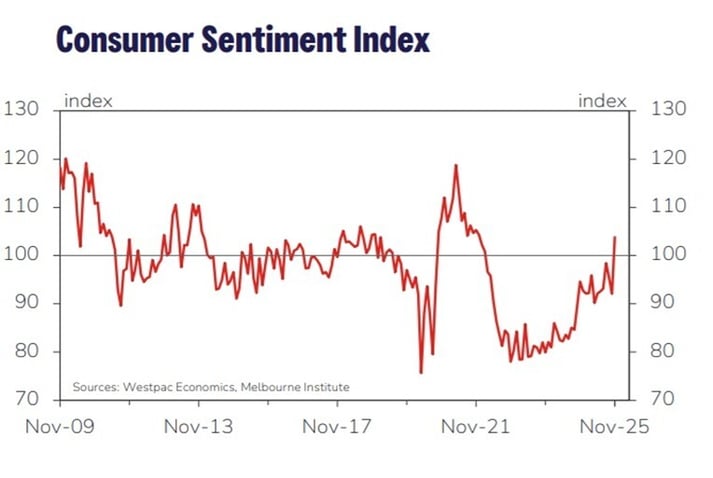
Firstly, consumers became very scared when the pandemic hit.
Then they became euphoric when interest rates were cut to the zero lower bound and stimulus packages were handed out by the government.
But then they got scared again as interest rates were jacked up to cool the overheating economy.
More lately as we have seen three interest rate cuts, the consumer sentiment index has brightened up again!
What does it all mean?
Well, as you can see above, this can all be a bit circular.
The economy picks up - which is good! - but then interest rates go up, which consumers with mortgages don’t like so much.
Then the economy slows down - which is not so good! - but then interest rates go down, which consumers with mortgages enjoy much more.
And round and round we go…
‘Consumer confidence’ is only so useful…
To what extent does consumer confidence as reported in such surveys impact property prices?
And is there a clear link between movements in the consumer confidence index and property prices?
Well, at the headline level…not very much, it must be said.
However, when we move down a level, we can find more useful information in the consumer sentiment surveys.
Can you use consumer confidence to predict the market?
When we drill in a little further, consumer sentiment as it relates to unemployment expectations and interest rate expectations play a key role in property purchase decision-making.
And, more specifically, the time to buy a dwelling sub-index and the house price expectations sub-index provide a handy reading as it relates to housing market sentiment.
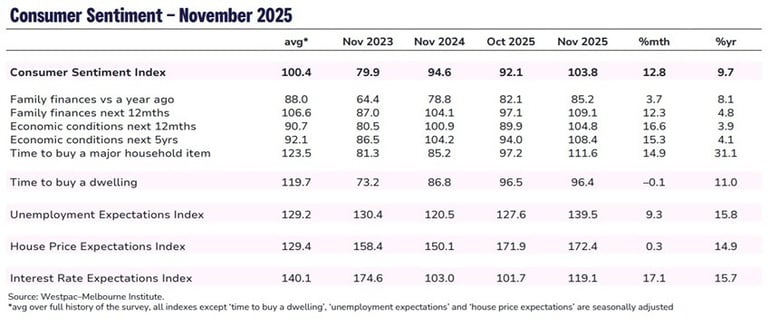
In November 2025, the house price expectations index hit a new cycle high of 172.4, absolutely miles above the long-run average of 129.4.
According to Westpac, just over 80 percent of consumers expected prices to rise over the following 12 months.
Expectations were stronger in South Australia (179) and Queensland (175) but lagging in Victoria (165).
But the time to buy a dwelling index was below average, as some consumers fear that they missed the boat for this market cycle, especially in Perth and Western Australia.
The psychology of property buying decisions
In an ideal world we could just look at the above indexes and pick the perfect time to buy.
Unfortunately, it’s never going to be that easy, since these readings can be lagging rather than leading indicators, with house price expectations rising after housing prices have risen (and vice-versa when the market is falling).
Therein lies the psychology of property buying decisions.
Often the best time in the cycle to buy is when the media headlines are at their most negative.
Some consumers still believe there is a potential property bubble and are waiting endlessly for the day for property prices to become cheap.
Others are fatalistic and feel they've been completely priced out of the market. They’ve given up.
And then other consumers are realists and realise they must make decisions to get into the property market regardless of interest rates or consumer confidence numbers, as they see the success of long-term investing.
They need to move on with their lives, so they take action when they can afford to do so.
What holds buyers back
What are some of the key reasons that hold people back from making a property-buying decision?
There are many potential factors: fear of debt, negative media stories, or fear of making a mistake, to name but a few examples.
Others want to make a purchase but become overwhelmed with all the different information out there these days, in turn suffering from analysis paralysis.
How can smart home buyers and investors build their confidence to make better decisions?
By conducting plenty of market research, saving a reasonable deposit so that you aren’t over-stretching, by taking a medium-term view rather than stressing about what might happen over the next 12 or 24 months, and by engaging an expert to assist you with the purchase.
Pete Wargent
petewargent.blogspot.com.au
To have one of our friendly Buyers' Advocate's contact you, click here to:
 or
or
call us on 1300 655 615 today.



.svg)
.svg)
.svg)