By Rich Harvey, CEO & Founder, propertybuyer.com.au
Last month, a couple sat across from me at our office, coffee in hand, and proudly slid a printed list across the desk.
"We asked ChatGPT for the top growth suburbs in Melbourne," they said. "It gave us percentages, reasons, even a timeline. We are thinking of putting an offer in on Footscray."
I smiled, thanked them for doing their homework, and gently asked, "What happens if the AI training data is two years out of date? Or if it is just repeating what property bloggers wrote during the last cycle?"
Their confidence wavered. You could see the shift immediately. And rightly so.
Because here’s the truth.
AI is incredibly useful for gathering information.
But it is dangerous when used to make decisions.
And property is a decision business. We have all felt the pull. Artificial intelligence is everywhere now, promising to simplify complex decisions with a single prompt. But real estate is not a language exercise. It is a living, breathing market shaped by council approvals, supply constraints, demographic shifts, interest rates, and off market activity. When you ask AI where to buy, you are not getting a forecast. You are getting a polished summary of what has already been said.
The Problem Isn’t AI. It’s How People Are Using It.
Artificial intelligence feels powerful because it delivers confident answers quickly.
Ask it where to buy, and you’ll get:
-
Suburb recommendations
-
Growth forecasts
-
Neatly packaged reasoning
It sounds like expertise. But it isn’t.
It’s a summary of what has already been written, not a prediction of what is about to happen.
Or put more simply:
AI predicts the next word. Not the next hotspot.
And in property, that difference can cost you hundreds of thousands of dollars.
This is not just our professional opinion. In February and March of this year, Microburbs, a leading Australian property data platform, ran a rigorous, transparent experiment. They fed the exact same prompt into seven different versions of GPT: "Name 20 suburbs in [state] most likely to experience growth, with expected percentages and reasoning."
Then they tracked what actually happened.
The results were striking. Six out of seven models underperformed the broader market. Across 6,888 scored predictions, AI picked suburbs grew 0.35% per year slower than a random selection. On a one million dollar property, that is roughly $7,789 in lost equity simply by following AI advice instead of picking at random.
As Luke Metcalfe, Microburbs Founder and Chief Data Scientist, explains: "GPT is trained on internet text. It knows which suburbs get talked about. It knows the cliches: 'close to the CBD', 'infrastructure investment', 'lifestyle appeal'. But popular suburbs are already priced in. The growth happens in the places nobody is writing about yet."
What That Actually Looks Like for Buyers
It is one thing to read a percentage on a screen. It is another to see how it plays out in real portfolios.
One AI model identified Peppermint Grove in Western Australia as a top growth pick. Sounds prestigious, right? Over the next 38 months, it grew 15.6%. Not terrible, until you learn the WA average grew 61%. If you followed the AI on a one-million-dollar investment, you would have missed out on nearly $454,000 in equity compared to a random WA suburb.
In Tasmania, AI ranked Launceston as its second-strongest pick, predicting six percent growth driven by infrastructure and amenities. Instead, median house prices fell 13.4%. In Victoria, Caulfield North dropped 22.9% while the state grew 7.2%. These were not buried suggestions. They were top-tier recommendations, delivered with confident-sounding percentages and tidy reasoning.
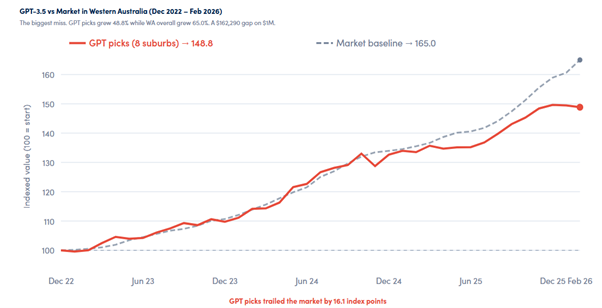
Source: Microburbs 2026
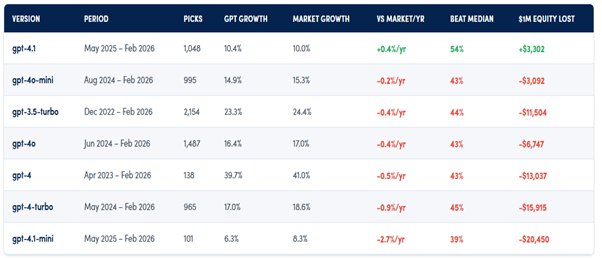
Source: Microburbs 2026
Why AI Cannot Read Property Markets
Language models are brilliant at pattern recognition. They scan millions of articles, blog posts, forum threads, and news reports, then learn to predict what comes next. But property forecasting does not live in text. Property markets are driven by live signals.
Real growth signals include:
-
Supply pipelines and development approval volumes
-
Demographic shifts and interstate migration patterns
-
Wage growth and employment hubs by postcode
-
Days on market trends and auction clearance rates
-
Council zoning changes, school catchment adjustments, and infrastructure timelines
-
Off market activity and buyer sentiment
None of these are reliably captured in AI training data. By the time a suburb is being widely discussed in articles, podcasts, or social media, the early growth window has usually closed. AI does not know what is happening now. It knows what was written historically.
The Gap Most Buyers Don’t See
This is where many buyers get caught.
They believe they are making a rational, research-driven decision.
In reality, they are following consensus.
And consensus in property is expensive.
Because when everyone agrees a suburb is “a great buy”:
-
Demand is already elevated
-
Prices have already moved
-
Competition is already intense
You are no longer early. You are late, just with better justification.
What Actually Works (And How We Do It)
At Propertybuyer, we use technology every day. It helps us process information faster and organise research more efficiently.
But we do not outsource judgement.
Because the real value is not in the data itself. It is in how you interpret it.
We track:
-
Weekly hedonic price movements, not historical snapshots
-
Direct conversations with agents, town planners, and local networks
-
On-the-ground insight, what is happening street by street, not suburb averages
-
Strategic alignment, ensuring the property fits your goals, not just a growth narrative
We are not looking for what is popular.
We are looking for what is changing. And just as importantly, what is not yet obvious to the broader market.
Let us Cut Through the Noise
I completely understand why AI feels tempting. The property market is complex, and it is exhausting to sift through conflicting headlines, agent hype, and endless spreadsheets. But outsourcing your biggest financial decision to AI is like asking a weather app to predict a storm based on last year's social media posts.
If you have been running prompts, feeling overwhelmed by the noise, or just want a clear, data-backed strategy tailored to your situation, we at Propertybuyer would love to help. Let us grab a coffee, map out your goals, and build a plan grounded in live market signals rather than recycled blog posts.
Property investing is not about finding what is trending. It is about finding what is turning. And that is a conversation best had with a team that reads the data, walks the streets, and puts your goals first.
To discuss opportunities in your area or explore properties that align with your objectives, call us on 1300 655 615 or send your enquiry today.
Give us a call on 1300 655 615 to start a conversation about your next property purchase, or click here to send us your enquiry today.
To have one of our friendly Buyers' Advocate's contact you, click here to:
 or
or
call us on 1300 655 615 today.



.svg)
.svg)
.svg)