By Rich Harvey, CEO & Founder, propertybuyer.com.au

For the past few weeks, the phone has been ringing the other way.
Twelve months ago, our buyers' agents were the ones chasing agents for stock. Homes sold before the second open. Auctions ran hot. Now real estate agents are calling us, asking if we have any buyers. The queue has thinned. The urgency has gone.
That is the clearest read I can give you on where the market sits.
The Federal Budget has rattled the market. Sentiment has plummeted. The fundamentals have not. Here is what it means for home buyers, investors and commercial buyers right now.
So let me tell you what has actually happened, why so many buyers and investors have gone quiet, and where I think the real opportunities are hiding.
Budget night changed the mood overnight
On 12 May, the Federal Government handed down a Budget that few in the property industry saw coming. With a stroke of the pen, the Treasurer quarantined negative gearing losses to brand new residential purchases. On top of that, the 50% Capital Gains Tax discount will be replaced from 1 July 2027 with an inflation-based indexation model and a minimum 30% tax on net gains. The one carve-out: new builds can still access the full 50% CGT discount under the new rules, and properties held before Budget night are grandfathered.
Let me be direct: these are material changes. They reduce the after-tax return on established residential investment property. They increase the complexity of portfolio decision-making. And for the segment of investors who relied on negative gearing as an income-offset strategy, the numbers now look meaningfully different.
But I want to separate what has genuinely changed from what the headlines are making it sound like. The fundamentals of the Australian property market, the supply shortage, the population growth, the migration numbers, have not been touched. The Budget did not build more houses. It did not slow the rate of overseas arrivals. It did not suddenly create land in the suburbs people want to live in. We remain structurally undersupplied, and that undersupply will underpin this market for the next five to ten years regardless of tax settings.
In addition ,the RBA lifted the cash rate to 4.35% in May, and with negative gearing also coming out of the way the banks assess borrowing, capacity has tightened. It is the lower income investor who feels that first. None of this lands evenly across every city or every price point.
Consumer confidence has dropped away, and property sentiment has gone with it.
Cotality's national index was flat in May, with Sydney and Melbourne leading the softening. Auction clearance rates ran close to 50% through the back half of the month, well down on the 65% we saw a year ago. Home sales nationally are tracking about 2.2% below a year ago, and in Sydney and Melbourne they are down 17% and 14%. There is more stock on the market than there has been in a long while, which, as Cotality puts it, is handing buyers more choice and better leverage.
But there is no such thing as one Australian market, and the spread between the capitals right now is as wide as I have seen it.
What we are seeing across the capitals
Sydney
Cotality has values down 0.9% in May, now 2.1% below their November peak, though still up 2.3% over the year, with a median around $1.28m. Home sales are running about 17% below a year ago and there is more stock on the market, so buyers finally have room to inspect twice, think, and negotiate. The rental side stays tight, with asking rents up 7.3% over the year.
Melbourne
This is shaping as the value play. Values eased 0.8% in May and are roughly flat over the year, with a median near $813k, the most affordable of the big east coast capitals. There is good depth of stock in the middle ring and realistic vendors are still transacting, which makes for some of the most balanced conditions upgraders have seen in years. Asking rents are up 6.1%.
Brisbane
Cooling from a boom, not falling. Values still rose 0.9% in May and are up a remarkable 19.1% over the year, with a median around $1.13m. Demand under $1m is still strong from first home buyers and investors alike, vacancies are tight at 0.8%, and asking rents are up 8.1%. The heat has come out of the top end, where buyers are no longer prepared to overpay.
Perth
Still the strongest of the capitals. Values rose 1.5% in May and are up 25.8% over the year, with a median about $1.05m. The pace is easing, but there is no sign of a reversal, stock is critically tight with vacancies near 0.6%, and rents are up 6.3%.
Adelaide
Adelaide is still grinding higher. Values rose 0.5% in May and are up 12.3% over the year, with a median around $951k and some of the tightest vacancies in the country at 0.7%. Rent growth has slowed to 4.6%, but it remains one of the most balanced markets going around.
Sources: Cotality Home Value Index, released 1 June 2026 (values to 31 May 2026); SQM Research National Vacancy Rates and asking rents, April 2026 (released 12 May 2026).
Why everyone has hit pause
Most of the buyers and investors we speak to have not walked away. They are waiting.
They want the dust to settle on the tax changes. They are worried about catching a falling knife. Investors are not sure which way to jump, if at all. And plenty of home buyers are quietly worried they have missed the chance at last year's prices.
All of it is fair enough. But sitting still has a cost too, and the people waiting are the very reason there is so much room for the ones who move.
Here is what has not changed
|
The fundamentals have not changed because of the Budget. We are still badly undersupplied, driven by sustained migration, and that imbalance is set to run for the next five to ten years. |
You can see it in the rental market. Vacancies sat at just 1.2% nationally in April on SQM's data, still well below historical norms, and asking rents are up 7.3% over the year, led by Brisbane at 8.1% and Sydney at 7.3%. A Budget can rattle confidence for a season. It does not build the homes we are short, and nothing about construction costs is getting cheaper.
We have seen this film before. The early 90s recession. The GFC. The APRA crackdown. Covid. Each one felt like the end at the time. Each one turned out to be short and shallow next to the serious upturn that followed.
The opening this creates for home buyers
Here is the part that gets lost in the noise. A slower, more nervous market is not bad news for everyone. If you are a prepared home buyer, this is about as good a set of conditions as we have seen in years.
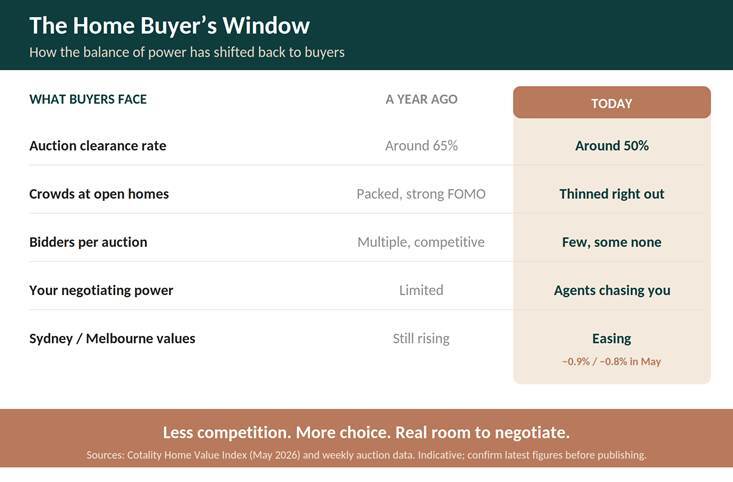
The balance of power has swung back toward buyers across almost every measure that matters.
Think about what those shifts mean when you are the one buying. There are fewer bidders in the room, so you are not being pushed past your limit by three other emotional buyers on the day. There is more on the market, so you have genuine choice instead of fighting over the one good home that came up that month. And when agents are ringing us looking for buyers, the whole conversation changes. We can push harder on price, on terms and on settlement than we could a year ago.
You are also buying into softness rather than a peak. Picking up a quality home while Sydney and Melbourne are easing is the opposite of buying at the top of a frenzy.
There is a quieter advantage on top of that. With investor borrowing capacity squeezed, there are simply fewer investors bidding against owner occupiers for the same family homes. For first home buyers and upgraders, that is a real tailwind.
If you are upgrading, the maths gets even better
Upgraders are probably the biggest winners right now. The top end usually falls further than the entry level, so when the whole market eases, the gap between what you sell and what you buy gets smaller.
Take a simple example. You own a home worth around $1.4m and you are looking at a $2.2m upgrade, a step up of $800,000. If the place you are buying eases 5% while your own only softens 3%, that step up now costs about $674,000. Roughly $126,000 less, just for moving while others wait. The dearer the home you are moving into, the more it works in your favour.
(Illustrative figures to show the mechanism, not a forecast.)
And for investors, the game has shifted
For investors the picture is more nuanced, but it is a long way from the disaster the headlines suggest.
Yes, the rules have changed. With negative gearing curtailed on established property, you can no longer lean on a tax loss to carry a hungry asset. The focus moves to where it probably should have been all along, which is cash flow and quality.
And cash flow is actually improving. With asking rents up 7.3% in Sydney, 8.1% in Brisbane and into the teens in Hobart and Darwin, and prices easing in the larger cities, the yield on a well chosen property is getting better, not worse. The combined capital gross yield has lifted to about 3.45%, its highest since the middle of last year. Sydney still runs tight near 3.2%, but markets like Darwin at 6% and Hobart now offer genuine income stories.
So the investor who does well from here is not the one chasing the next hot suburb on heavy leverage and a tax break. It is the one buying a quality property in a tightly held area, on a yield that genuinely stacks up, that can hold through different conditions. And with so many investors on the sidelines, there is far less competition for exactly that kind of stock.
There may also be a window worth exploring if you owned before budget night. Depending on how the new transition rules apply to a property you already hold, converting your home into an investment can still make good sense. This one really is worth a conversation with your accountant, and with us, before you act.
What this means, whoever you are
If your finance is sorted and your brief is clear, hesitation is the expensive option, not the safe one. The buyers and investors who do well in markets like this are not the ones who pick the exact bottom. They are the ones who buy a quality asset, in the right spot, while everyone else sits on their hands.
That is the work we do every day, and this is exactly the kind of market where having someone in your corner pays for itself.
Thinking about your next move?
If you would like to talk through what this market means for your plans, call the Propertybuyer team on 1300 655 615, or reply to this email and we will be in touch.
To have one of our friendly Buyers' Advocate's contact you, click here to:
 or
or
call us on 1300 655 615 today.
This update is general information only and does not take your personal circumstances into account. It is not financial, tax or investment advice. Please seek your own professional advice before making any property decision.



.svg)
.svg)
.svg)