By Rich Harvey, CEO & Founder, propertybuyer.com.au
What the new tax rules mean for the investor weighing up $850k versus $1.5 million
Most of the investors I'm talking to right now want to borrow less than they could. And I understand why.
The May Budget changed the playbook overnight. Lenders Mortgage Insurance still feels like dead money. Interest rates are stubborn. And now that you can no longer offset rental losses from an established property against your salary income, the idea of taking on a bigger loan looks even scarier than it did a year ago.
But here's what I see, week in and week out, in the conversations we have with investor clients. The instinct to play it small is still costing them more than they realise.
Let me walk you through why.
The two numbers your broker hands you
Picture an investor with around $200,000 in genuine savings, ready to take their next step in the market. The broker comes back with the usual two options.
Borrow around $850,000 inside an 80% LVR and avoid LMI. Or stretch to $1.5 million at a higher LVR with LMI on top.
Same person. Same income. Same savings. Two very different decisions.
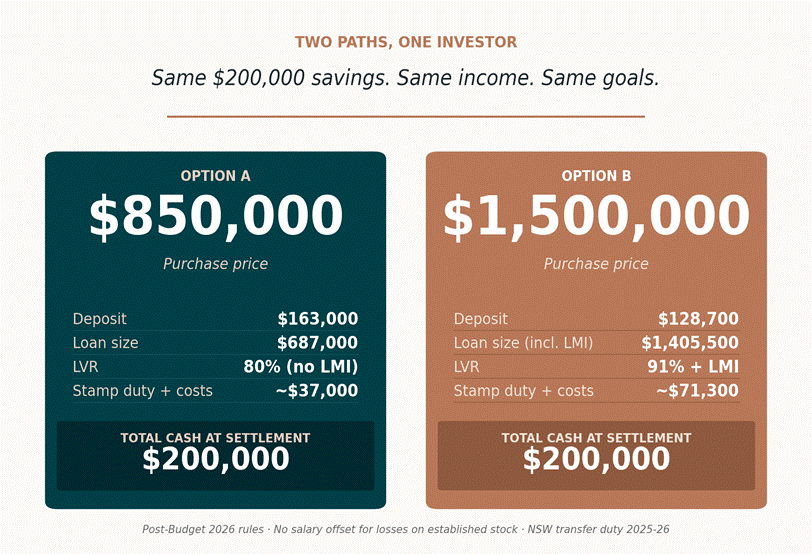
The structural difference between the two options before any growth or cash flow analysis.
For most investors, the smaller option just feels right. Less debt. No LMI. A lighter monthly load. It wins on every emotional metric you can name.
Run the numbers properly across a 10-year window, though, and the story turns. Even under the new rules.
What you actually fund each year
Under the May 2026 Budget changes, losses on established residential property purchased after Budget night can no longer be deducted against your salary or business income. They get quarantined and carried forward, to be used against future rental income or against the capital gain when you eventually sell.
In practical terms, that means more of the holding cost comes out of your pocket today.
On the $850,000 property at a 6.3% interest-only investment rate, your annual interest is about $43,300. A 3.5% gross rental yield brings in $29,800. After property management and holding costs, you're funding around $20,000 a year out of cash.
On the $1.5 million property, interest comes to $88,500. Rental yields on higher-priced blue-chip stock typically sit lower, around 3%, so you collect $45,000 in rent. After all the costs are accounted for, you're funding about $55,000 a year.
The annual gap between the two scenarios is roughly $35,000. Over 10 years, that's $350,000 in extra cash you'll need to fund out of pocket.
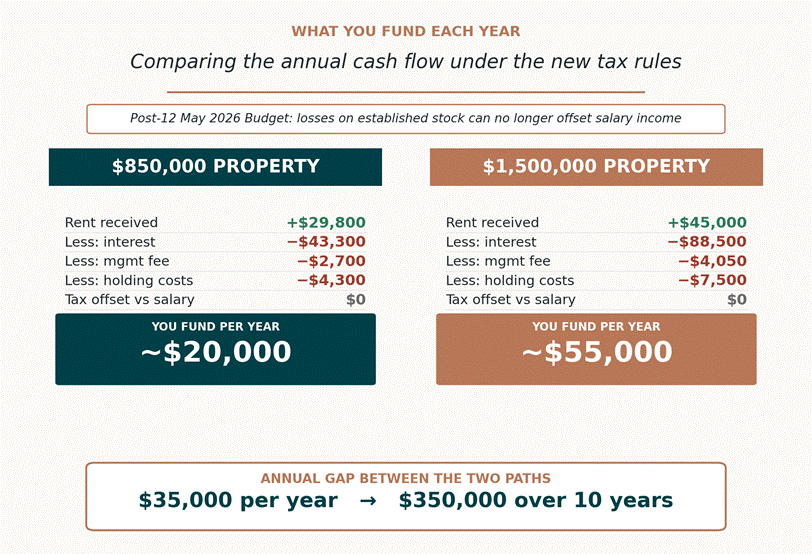
The cash flow gap. Bigger under the new rules than it was under the old.
That's a serious number. And it's the number that scares most investors away from the bigger property before they've even looked at what they're getting in return.
But here's what most cash flow calculators miss.
What year ten actually looks like
Even on identical growth assumptions, the bigger property delivers a much bigger equity outcome. Compounding does what compounding does against a larger base.
At a conservative 5% per annum, the $850k property grows to about $1.38 million in 10 years. A gain of $535,000. The $1.5m grows to $2.44 million. A substantial gain of $943,000.
That's $408,000 in additional equity for the $350,000 you'll have put in. Roughly a one-for-one trade. Not exactly compelling on its own.
But the equal-growth scenario isn't actually the realistic one. Not by a long way.
The growth differential nobody factors in
A $1.5 million property in Sydney or Melbourne isn't an $850k property scaled up. It sits in a fundamentally different part of the market. Better land. Better location. Closer to the things that drive long-term demand: employment hubs, water, transport, schools, lifestyle precincts.
In the suburbs we typically buy in for our investor clients, which are high demand/ low supply areas underpinned by strong amenities and infrastructure, the market has historically delivered around 6% to 8% per annum over the long run. The outer-fringe stock, which is what an $850k budget often buys in our major cities today, tends to track closer to 3-4%. This is a key distinction to watch for when property spruikers are promoting house and land packages on the city fringes.
Apply realistic growth rates and the picture changes again. The $850k at 4% reaches $1.26 million. Gain of $410,000. The $1.5m at 6.5% reaches $2.82 million. Gain of $1,320,000.
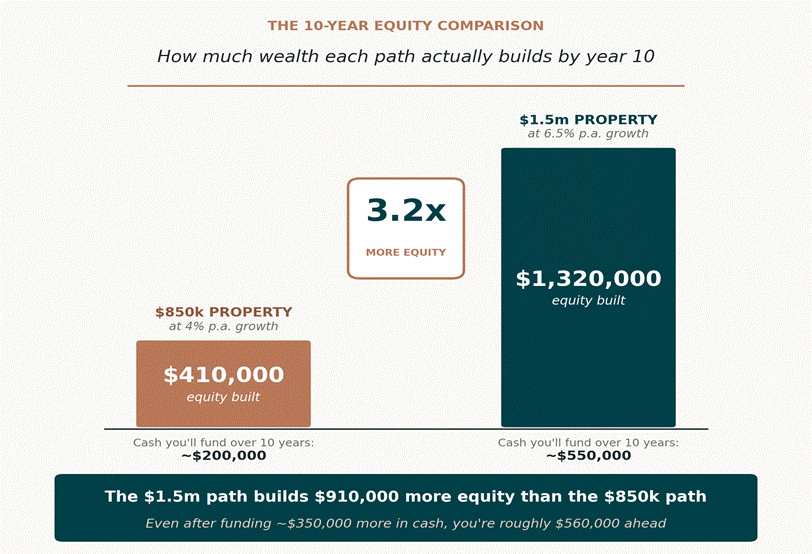
The $1.5m path builds 3.2x more equity over 10 years, even after the higher cash contribution.
There's another point worth making. Those accumulated rental losses you've been carrying don't simply vanish. When you sell, they reduce your eventual capital gain and the tax payable on it. So a meaningful chunk of that extra cash you put in comes back to you on exit, even under the new CGT regime.
Why "playing it safe" actually isn't safe
When investors choose the smaller property thinking they're managing risk, they're really just choosing one risk over another. They've reduced short-term cash flow risk. In exchange, they've taken on the risk of underperformance over the long term.
That risk matters more now than it ever has. Under the old rules, even a mediocre property got some tax shelter that helped subsidise the holding cost. Under the new rules, that shelter is largely gone for established stock. Which means the asset itself has to do the heavy lifting.
A decade in, the smaller-budget investor often finds the equity in their property won't comfortably finance a second purchase. The cash flow drag is still there. The growth has been modest. And the borrowing power they had as a younger investor with a longer working horizon is gone.
The investor who stretched into the better asset, with a sensible buffer and the right loan structure, ends up with the equity to keep buying. That's how real property portfolios get built in this country. Not by minimising debt. By attaching the debt to the right asset.
The decision deserves more than a gut feel
None of this is an argument for borrowing the maximum every time. It's an argument for making the decision with full information in front of you. And in a post-Budget environment, with tax shelter no longer carrying mediocre property, asset selection matters more than it has in a generation.
The right answer depends on your job security, your buffer, your appetite for cash flow drag, whether you're planning to buy again inside the decade, and how you respond to rate movements or vacancy.
What I can tell you is that across more than 20 years of investor conversations, I've rarely seen someone regret stretching for the right property in the right location. I've seen plenty quietly regret playing it small.
Before you commit either way, stress-test both scenarios. What happens if rates climb another 1%. What if the property is vacant for six weeks. What if one income drops away for six months. If the numbers still hold up, you have your answer.
And if you'd like a second set of eyes on the analysis, including a view on which suburbs are positioned to deliver the kind of growth that makes this maths work under the new rules, that's exactly what our team does every day.
|
Want to map your own scenario? To have one of our friendly Propertybuyer Buyers' Agents contact you, send us your property brief or call us on 1300 655 615 today. |
Figures are illustrative for educational purposes. Based on a 6.3% interest-only investment loan, 3.5% / 3.0% gross rental yields, NSW 2025-26 transfer duty, and the May 2026 Federal Budget changes to negative gearing on established residential property. This article is general in nature and does not constitute financial, tax or legal advice. Personal advice should be sought from qualified professionals before acting on any information.
Give us a call on 1300 655 615 to start a conversation about your next property purchase, or click here to send us your enquiry today.
To have one of our friendly Buyers' Advocate's contact you, click here to:
 or
or
call us on 1300 655 615 today.



.svg)
.svg)
.svg)