By Rich Harvey, CEO & Founder, propertybuyer.com.au

Sentiment has turned. The fundamentals have not. The window of opportunity during uncertain times.
A new phase of negative sentiment
For the first time in nearly two years, the conversation around property has flipped. Headlines have moved from "record highs" to "softening", auction clearance rates are sitting noticeably below the long-run average, and listings are starting to climb in Sydney and Melbourne. With the RBA set to hammer inflation by pushing up rates another 2 or 3 times, there’s been a dramatic drop in consumer confidence and the mood among buyers has shifted from competitive to cautious.
I want to call this out plainly: we are now entering a new phase of negative market sentiment. That is not a forecast. It is what is showing up in the data, in the auction rooms, and in the conversations my team is having every day across the country.
This is buyer psychology, not market collapse
What changes in moments like this is not the property market. It is the people looking at it. The same four-bedroom home that had nine bidders in February is now passing in. The same three-bedroom townhouses that had a queue at the open is now sitting on the portal for 40 days. Stock has not magically deteriorated. Buyers have flinched.
This is the recurring pattern across every cycle I have seen in 25 years of buying property: when sentiment turns, decision-making gets emotional. Buyers wait for "the bottom" (a point you can only ever identify in hindsight – and no one rings the bell at that point), they read negative headlines as confirmation, and they hesitate at exactly the moment competition has thinned out. That hesitation is itself the opportunity.
The fundamentals of the Australian property market have not changed. Population is still rising. Immigration is still strong. Construction is still well below what we need. Land remains scarce in the suburbs everyone wants to live in. None of that reset because the news cycle gets gloomy.
Property Prices slowing temporarily
The Domain House Price Report for the March 2026 quarter confirms the picture. Annual growth is still positive in every capital city, but the quarterly numbers tell the more honest story. Sydney and Melbourne house prices have gone marginally backwards for the first time in this cycle, while Brisbane, Adelaide and Perth keep grinding higher on tight supply.
Sydney
The headline number, $1.79M, is up 6.6% over the year but slightly (-0.04%) down on the December quarter. Sydney is the clearest example in the country of how this cycle is diverging: the lower quartile for prices under $1.5m is still very strong – driven by first home buyers taking full advantage of the 5% deposit scheme, the middle is steady but slower, and the prestige end has also cooled visibly. There is clearly a flight to quality properties and vendors are increasingly needing to adjust expectations to meet the market.
Melbourne
Melbourne houses dipped 0.6% in the March quarter to $1.08M, the first quarterly slip since the recovery began. Yet annual growth is still +4.4% and the unit market actually outperformed houses on a yearly basis at +5.5%. Melbourne property now sits at a 40% discount to Sydney -– this value gap to Sydney is now the widest it has ever been, making it highly attractive to home buyers and investors.
Brisbane
Now the second-most expensive capital for houses, Brisbane has run +20.4% over the year to $1.21M, with units adding an extraordinary +23.0% to $800,500. Migration into South-East Queensland, infrastructure spend in the run-up to 2032 Olympics, and a chronic shortage of family-suitable housing remain the key structural drivers. Vacancy rates remain critically low and the runway for further capital growth looks strong and well supported.
Adelaide
Adelaide houses went past $1.09M with another 5.2% quarterly gain, and units lifted 18.7% over the year. Tight supply and steady, defensive demand continue to underwrite price stability. The "cheap capital" label simply does not apply anymore. With the house-price-to-income ratio now at nine times, affordability will increasingly cap further gains.
Perth
Perth is the standout for past growth in the quarter: houses +5.7% to $1.18M, units +6.0% to $700,351, and unit prices up 27.8% year on year. Resources, in-migration and a chronically undersupplied rental market continue to do the heavy lifting. The hardest market in the country in which to find quality stock at a fair price.
House prices, capital cities (Mar Q 2026)
.png?width=840&height=673&name=House%20prices%2c%20capital%20cities%20(Mar%20Q%202026).png)
Source: Domain House Price Report March 2026
Unit prices, capital cities (Mar Q 2026)
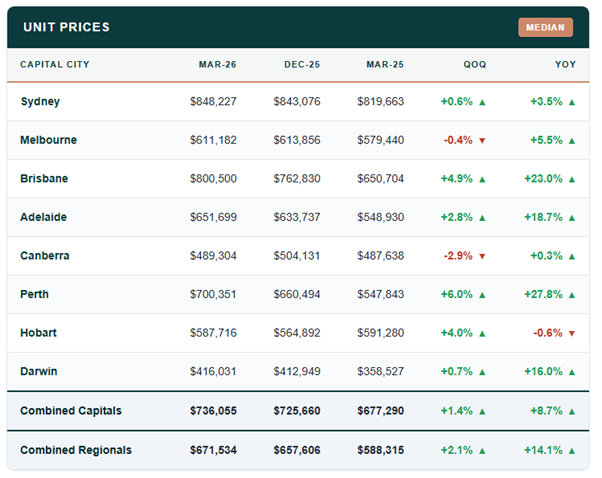
Source: Domain House Price Report March 2026
We are now in a multi-tier market
The single most important thing to understand about the current market is that "the property market" is no longer one market. There are multiple markets, and they are pulling in various directions. The headlines describe an average and tells you nothing about what is happening on either end of the price spectrum.
Tier 1: Below the First Home Guarantee 5% deposit caps
This is roughly under $1.5M in Sydney, under $1M in Melbourne, $1M in Brisbane, and around $850K to $900K in Adelaide and Perth. It is the most competitive corner of the entire country right now. With the expanded 5% deposit scheme removing LMI for eligible buyers, first-home buyers are out in force. We are seeing multiple offers, short campaigns, and prices at or above guide. Most of the year-on-year growth Domain just reported (+20.4% Brisbane houses, +27.8% Perth units, +18.7% Adelaide units) is being driven from this band. If you are a buyer here, you are not in a soft market. You are competing against a deep, motivated pool, with a tailwind from government policy.
Tier 2: The middle ($1M to $2.5M, varies by city)
Still moving, but with genuine negotiation returning. Premium owner-occupier demand is intact, particularly for renovated family homes in good school catchments. The urgency, however, has gone. Vendors who held firm in February are increasingly meeting the market in May. This is where buyer's agents are quietly winning the best results right now: same suburbs, same quality of stock, materially better pricing than three months ago.
Tier 3: Above $3.0M
Softened considerably. We are seeing 5% (and up to 10%) off late-2025 peaks in parts of Sydney's Eastern suburbs, Northern Beaches and Lower North Shore, longer days on market across Inner-eastern Melbourne, more passed-in stock at auction, and a clear willingness from vendors to negotiate post-auction. Buyers in this segment tend to be finance ready; they can afford to wait and sit on the sidelines.
CoreLogic (Cotality) Home Value Index, April 2026
The Cotality Home Value Index for April 2026 also confirms the national property market has decisively shifted from broad-based growth to a two-speed market. The national index rose just 0.3%, the slowest monthly pace since January 2025, with Sydney and Melbourne both falling 0.6% and now sitting 1.0% and 1.9% below their late-2025 cyclical peaks. In contrast, Perth (+2.1%), Darwin (+1.3%), Brisbane (+1.2%) and Adelaide (+1.1%) continue to post solid monthly gains, with annual growth of 26.0% and 19.7% in Perth and Brisbane respectively. Regional markets are also outperforming the capitals (12.0% vs 9.1% annual), though even regional momentum is easing. The clearest internal divergence is at the price-point level: lower-quartile values are outperforming everywhere, with Sydney's bottom-tier houses up 2.9% year to date while the top quartile fell 3.3%.
The deceleration is being driven by a stack of compounding headwinds rather than a single shock: the February and March rate rises, oil prices sitting 30 to 50% above pre-war levels, an Iran-conflict-induced hit to consumer sentiment and stretched affordability and serviceability metrics. Markets are now pricing in at least two further 25bp hikes in 2026, which will keep buying capacity under pressure. Practically, this points to an environment where buyer urgency has dropped (auction clearances below 55% since late March, capital city sales 7.4% below the five-year average) but listing volumes remain constrained enough to prevent a sharp correction. For buyers, the window is opening in Sydney and Melbourne premium stock where vendor expectations have not yet caught up to softer conditions, while the mid-priced western and South Australian capitals still favour sellers but are clearly losing steam, suggesting any acquisitions there should be priced for a slowing, not accelerating, market.
Cotality Home Value Index, April 2026
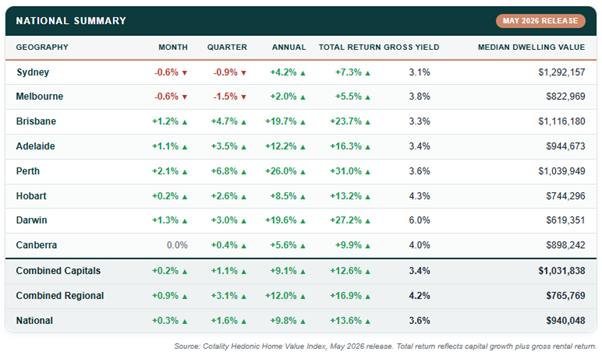
Note that Cotality report “Median Dwelling Value” which is a combined house and unit figure to represent the median values.
Why now is the window
Let me be direct. Downturns like this do not last. The combination of softer sentiment, less competition above $1.5M, more stock to choose from, and vendors who are increasingly meeting the market is a genuine alignment in favour of buyers in the middle and upper segments. We have not had this much negotiating leverage above $2M since late 2022.
The fundamentals that got us here, undersupply, population growth, scarcity of well-located stock, are all still in place. Two or three rate cuts (which the market is now pricing in for the back half of the year) will reignite competition very quickly, and the soft top end is where the snap-back will be sharpest. Sentiment can turn just as fast as it has turned negative.
Market downturns are not to be feared. They should be embraced! Every long-term property investor I know built their portfolio in years that felt uncomfortable, not in years that felt euphoric. The window is open, especially above $1.5M. It will not stay open for long.
If you have been waiting for "the right time", this is closer to it than the headlines suggest. The buyers who act decisively in the next few months, with proper due diligence and a clear segment strategy, will be the ones quietly compounding wealth while everyone else is still
Speak With the Propertybuyer Team
If you’re considering purchasing a home or investment property and like help navigating the current market with clarity and confidence, my team of buyers’ agents and I are always here to guide you.
Propertybuyer
1300 655 615
Give us a call on 1300 655 615 to start a conversation about your next property purchase, or click here to send us your enquiry today.
To have one of our friendly Buyers' Advocate's contact you, click here to:
 or
or
call us on 1300 655 615 today.



.svg)
.svg)
.svg)