Best Buyers Agency of the year - 2025


TL;DR
- Higher interest rates and the 2026 Federal Budget have changed what works in property investment. Most established residential property is now cashflow negative without the full tax offset.
- Purpose-built rooming houses are one of the few strategies that still pay their own way, delivering 8–10% net yields from multiple income streams under one roof, with new builds retaining full negative gearing exemptions.
- This page covers what the strategy involves, who it suits, what the real risks are, and how Propertybuyer sources and acquires these assets independently for investors, with no conflict of interest.
- Rich Harvey is hosting a free live webinar on this strategy on 28 October 2026 at 7:30pm AEDT. Register here.
On This Page
What Is a Rooming House Investment?
I've been a buyers' agent for 25 years. In that time I've seen a lot of strategies come and go. Rooming houses are not new but the way they fit a portfolio right now, particularly after the May 2026 Budget changes, is the most compelling I've seen them in a decade.
A rooming house is a residential property where each bedroom is leased separately to individual tenants, under a single ownership structure. Where a standard rental property generates one rent from one tenant, a purpose-built rooming house generates five, six, seven or more separate rents from the same building.
That is the structural difference, and it is why the yield arithmetic looks so different from a standard buy-to-let.
| Property Type | Typical Income Streams | Gross Yield (indicative) | Net Yield (indicative) |
|---|---|---|---|
| Standard 4-bedroom rental | 1 household rent | 3.5–5% | 2.5–3.5% |
| Purpose-built rooming house (5–8 rooms) | 5–8 individual rents | 10–14% | 8–10% |
Indicative figures. Individual results vary based on location, property type, total project cost and management. Net yield calculated after property management fees, utilities and vacancy allowance. Not financial advice.
The question I get more than any other since the Budget is: "Are there any property investment strategies that actually pay their own way?" For the right investor, in the right location, a purpose-built rooming house is one of the clearest answers to that question I've seen in years.
These are not converted houses.
The assets I source for clients are purpose-built for multi-tenancy from the ground up: compliant floor plans, fire separation, appropriate room sizing, and council-registered from day one. That matters enormously for both yield performance and exit value.
Why Rooming Houses Make Sense Right Now
Three things have converged in 2026 to make this strategy more relevant than it has been at any point in the past decade.
1. The 2026 Federal Budget Changed the Rules for Established Property
From 1 July 2027, negative gearing on established residential properties purchased after 12 May 2026 is removed. Losses from those properties can only offset rental income, not your salary. For investors who rely on negative gearing to make the numbers work on growth assets, this is a meaningful shift.
New builds are fully exempt. A purpose-built rooming house is a new build. That means it retains full negative gearing, and you retain your choice of either the 50% CGT discount or the new inflation-indexed discount. For investors building a portfolio, this is exactly the government's intention to incentivise new housing supply.
2. Australia's Rental Shortage Is Not Going Away
Demand for affordable, flexible rental accommodation continues to outstrip supply across most major cities and their near-urban corridors. The growth in single-person households, now over 25% of renters, has created a structural demand base for rooming accommodation that exists independently of broader rental market cycles. Rooming houses sit at exactly the intersection of supply shortage and high single-occupancy demand.
3. High-Rate Environments Reward Cashflow Assets
When rates are elevated, a portfolio weighted toward capital growth assets carries a significant monthly cost. A rooming house generating 8–10% net yield is more than an investment in its own right; it is a cashflow engine that covers the shortfall on growth assets and allows you to hold more property for longer without leaning on your salary to bridge the gap. That is the strategic role these assets play in a serious portfolio.
Free Live Event — 28 October 2026
Rooming House Investment Strategy: Cashflow and Equity Uplift in a High-Rate World
8–10%
Net yield target
Purpose-built, strong demand corridor
$1.2M–$1.9M
Typical total project range
Land, build and compliance
12–18 months
Typical build cycle
From acquisition to first income
This Strategy Suits Who?
This is not an entry-level investment.
A purpose-built rooming house is a 12–18 month project with total project costs typically ranging from $1.2 million to $1.9 million, depending on location, land price, build specification and council requirements. If you need returns from day one, this may not be the strategy for you.
The clients I put through this strategy share a common profile. They:
- Already own at least one other property
- Have equity or liquidity available to fund the project
- Have a specific problem to solve, usually a cashflow gap in a portfolio that is otherwise weighted toward growth
The Portfolio Scaler
- Has two or more existing properties, with a net worth of $2M–$5M
- Concerned about the July 2027 gearing changes eating into the return on established assets
- Looking for a cashflow strategy that funds the shortfall without requiring a salary top-up every month
The Yield-Focused Investor
- Primarily motivated by cashflow-positive returns, not just capital growth
- May have been priced out of standard buy-to-hold growth markets in Sydney and Melbourne
- Prefers a new build for the tax advantages under the 2026 Budget rules
- Understands the yield maths and wants net figures, not gross headlines
- Wants an expert to navigate compliance and finance without needing to become an expert themselves
The SMSF Investor
- Has a Super balance above $800K and is nearing or planning for retirement
- Working with a financial planner to rebalance their portfolio toward income-generating assets
- Wants to generate reliable retirement income from property inside a tax-efficient structure
- A rooming house's 8–10% net yield is well suited to this rebalancing goal, providing consistent income without relying on capital events
- Requires specialist SMSF lender navigation as most standard banks do not lend on rooming houses, and the lending structure for SMSF-held specialist property is specific
The Equity Recycler
- Sydney or Melbourne homeowner with $600K+ in usable equity
- Does not want to buy an established investment property that is now negatively geared without the full tax offset
- Looking to leverage existing equity into a new build that generates positive cashflow and retains the CGT discount
If you are not sure which profile fits your situation, or whether it fits at all, book a strategy call. A 15-minute strategy check today prevents 18 months of holding the wrong asset.
Want to know if this strategy suits your portfolio?
I'll tell you honestly in a 15-minute call — no obligation, no pitch.
What We Source
Not every property that could be used as a rooming house should be acquired as one. Part of what separates a well-performing rooming house from a compliance problem waiting to happen is the asset itself: its location, its layout, and whether it was built for this purpose from the start.
At Propertybuyer, we focus on purpose-built rooming houses rather than conversions.
Why?
A purpose-built dwelling is designed for multi-tenancy from the foundation, with correct fire separation, appropriate room sizing, shared amenity placement and council classification built in from day one. On the other hand, a converted house can carry hidden compliance gaps that only surface after you have settled.
Location criteria
Strong rooming house locations share common traits: proximity to hospitals (which generates demand from nurses, junior doctors, international medical workers), universities, and major public transport nodes. The yield arithmetic does not work in premium inner-city councils where land costs are too high to justify the spread. The locations that perform are near employment centres but outside the inner ring, where land is accessible and rental demand for affordable, flexible accommodation is consistent.
In Victoria, councils with established permit pathways and active rooming house markets include areas in Brimbank, Whittlesea, and parts of Hume. Queensland's south-east corridor is seeing growing activity. We assess state and council-level permit viability as part of the sourcing process, before any asset reaches a client shortlist.
Compliance screening
Rooming house compliance is not uniform across Australia. Victoria operates under the Rooming House Operators Act 2016, requiring registration with Consumer Affairs Victoria for properties with four or more residents. NSW, Queensland and other states each have their own classification systems. In some cases, local council discretion significantly affects whether a permit pathway exists at all.
We do not shortlist an asset until we have confirmed the zoning permits the intended use and that the building classification is appropriate for the number of rooms and residents planned. This is the step that protects you from acquiring a property that cannot legally operate as intended.
For a broader view of our acquisition service, see our full property search service. We also work with investors pursuing development site acquisitions as a complementary strategy.
The Honest Reality of Rooming House Investment Risks
I will not pretend there are none. Part of what I do as an independent buyers' agent is tell clients what the risks are before they commit, not after. There are 4 risks every serious investor should understand before pursuing this strategy.
- Finance is harder than standard residential. Most major banks treat rooming houses as specialised property. Lending is either restricted entirely or capped at 60–70% LVR, compared to 80% on a standard investment property. The typical structure is to finance the land or existing dwelling at standard residential rates, then refinance to a specialist lender once the purpose-built dwelling is complete. You need a finance specialist who has navigated this path before, not one working it out as they go.
- Management is more intensive than standard residential. Multiple tenancies under one roof means higher tenant turnover, utility costs that the operator typically covers (and factors into room pricing), and ongoing compliance monitoring. The operational complexity is real. The mitigation is working with an experienced rooming house operator from the start, not trying to manage it yourself or appointing a general property manager unfamiliar with the asset class.
- Exit liquidity is narrower than for a standard house. The buyer pool for a rooming house is smaller than for a standard residential property. When you sell, you are selling to another investor, not to an owner-occupier market. This is not a reason to avoid the strategy, but it is a reason to go in with a medium-to-long holding horizon and a clear understanding that this is not a liquid asset.
- A non-compliant asset can cost more to fix than it ever returns. The risk of acquiring a property that does not meet council or state requirements, or one that was converted without proper permits, is that you inherit a compliance liability. Council enforcement notices, required structural changes, and potential deregistration can eliminate years of income. This is precisely why compliance screening is the first step in our process, not an afterthought.
These are the exact reasons why you need a buyers' agent who understands this asset class specifically instead of one who treats it like any other residential purchase. Experienced property investors understand that honest risk disclosure is a sign of a good adviser.
How Propertybuyer Works
My first call with every client on this strategy is about whether it is right for them, not whether they will engage me. If the strategy does not fit your portfolio, your financial position, or your timeline, I will tell you that in the first conversation. For clients who proceed, this is what the process looks like:
-
Free strategy call
We discuss your portfolio, your goals, your available capital or equity, and your timeline. This is where I assess whether a rooming house acquisition belongs in your strategy, and if so, what the brief should look like. No obligation, no commitment.
-
Property brief and location targeting
Once we agree on the parameters, I build a sourcing brief: location criteria, project budget range, target yield, preferred build specification. The brief drives the search — I am not scanning listings at random.
-
On-market and off-market sourcing, compliance pre-screening
We search both on-market listings and our off-market network. Every potential asset is pre-screened for zoning viability, permit pathway, and council-level compliance before it is presented to you. You only see assets that pass that filter. Our full property search service covers both sourcing channels.
-
Feasibility review — net yield, not gross
I run the numbers on net yield: after management fees (typically 8–13%), utility costs, vacancy allowance, and the total project cost, not just the land price. You get an honest projection, not a headline figure designed to make the deal look better than it is.
-
Negotiation and purchase coordination
We negotiate on your behalf. Our property negotiation service covers price negotiation, purchase conditions, and settlement coordination with your solicitor and finance specialist.
-
Handover to your management and development team
After settlement, you move into the build and management phase with the specialists suited to your asset. We do not build rooming houses. We do not manage them. Our role ends at settlement, which means we have no financial interest in recommending a particular builder or operator.
Upcoming Live Webinar: 28 October 2026
On 28 October 2026 I'm hosting a free live webinar: "Rooming House Investment Strategy: Cashflow and Equity Uplift in a High-Rate World." I'm joined by a specialist panel who work in this space every day.
The panel covers the full picture: acquisition strategy, finance structuring for rooming houses (including SMSF applications), tax and depreciation, and property management from an operator who runs these assets. Seats are capped so everyone can ask questions live.
Presenters:
- Rich Harvey, CEO and Founder, Propertybuyer
- Greg Willmott, Buyers Agent, Propertybuyer
- Dean Parker, Founder and Owner, YSH
- Tom Johnson, Finance Specialist, Developer and Rooming Accommodation Investor
- Jeremy Iannuzzelli, Accountant and Founder, Praedium Partners
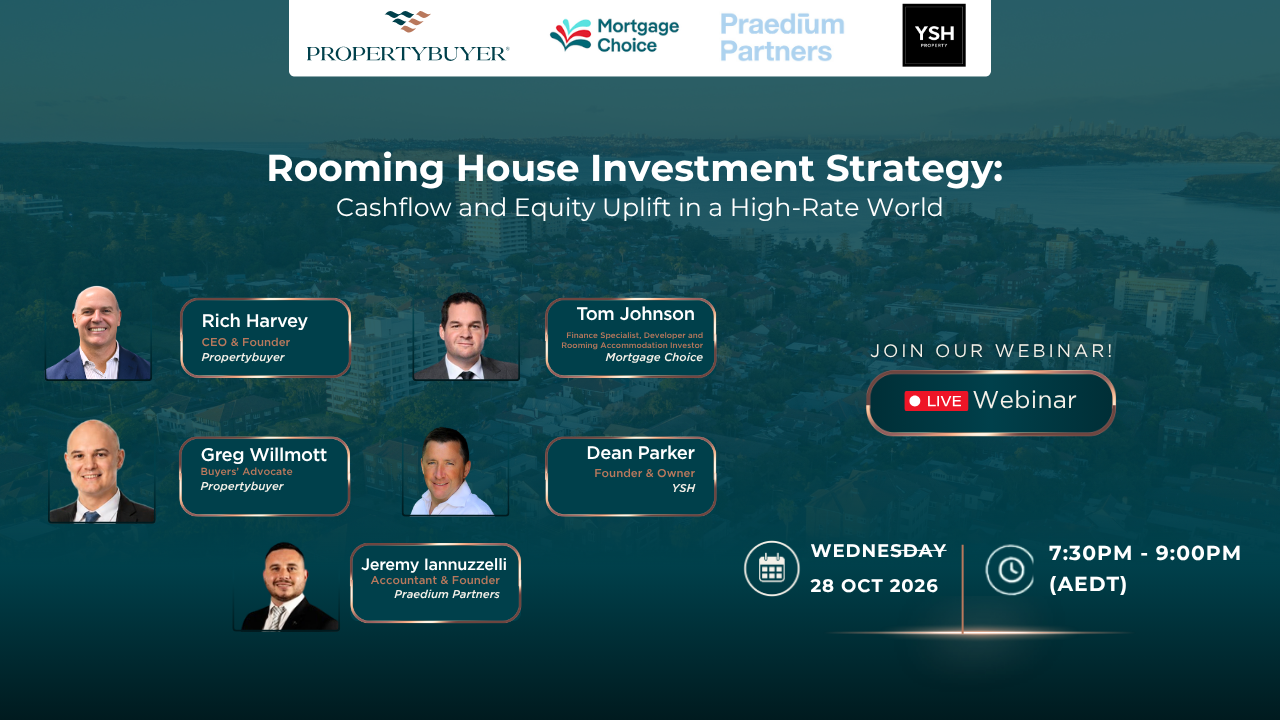
Free · Online · Seats Limited
Rooming House Investment Strategy: Cashflow and Equity Uplift in a High-Rate World
Can't attend live? Register anyway and we'll send you the recording.

Frequently Asked Questions
What net yield can I realistically expect from a rooming house investment in 2026?
The honest answer depends on total deployed capital, not just the property price. Net yields, after property management fees (typically 8–13%), utilities the operator covers, and vacancy allowance, typically run between 8% and 10% on purpose-built rooming houses in strong demand corridors near hospitals, universities and transport.
Gross yield headlines quoting 12–15% are real — before costs. When someone asks me what they'll actually put in their pocket, I tell them to plan on 8–10% net and be pleasantly surprised if the number is higher. I will not quote gross to make a deal look better than it is.
Is rooming house investment legal and compliant in all states?
Regulations vary significantly by state and even by council. Victoria has the most established framework under the Rooming House Operators Act 2016, requiring registration with Consumer Affairs Victoria for properties with four or more residents. NSW, Queensland and other states have their own classification systems.
The risk of buying without specialist guidance is acquiring in a zone where council permits are effectively impossible to obtain, or a property that fails fire safety classification requirements. Part of what we do at Propertybuyer is screen for compliance viability before anything reaches your shortlist.
How does the 2026 Federal Budget affect rooming house investments?
This is arguably the question that has made rooming houses more attractive than they have been in years. From 1 July 2027, negative gearing on established properties purchased after 12 May 2026 is removed. Losses can only offset rental income, not your salary. New builds are fully exempt.
A purpose-built rooming house is a new build. That means it retains full negative gearing and you retain your choice of either the 50% CGT discount or the new inflation-indexed discount. For investors building a portfolio, this is exactly what the government designed the new build exemption to do.
Can I finance a rooming house through my bank?
Most major banks treat rooming houses as specialised property and either restrict lending entirely or cap LVR at 60–70%. The typical strategy is to finance the land at standard residential rates (up to 80% LVR), complete the build, and then refinance to a specialist lender, or hold the original structure depending on your situation.
A good finance specialist who works regularly with this asset class navigates this from the start. The key is structuring the deal correctly before you commit, not trying to fix it after settlement. Our October webinar panel includes a finance specialist who works on this type of project regularly — register here to attend.
What type of investor is rooming house investment best suited to?
This is not an entry-level investment. A purpose-built rooming house is a 12–18 month project requiring $1.2 million to $1.9 million in total project capacity — land, build, compliance costs and holding costs during the build period. It suits investors who already own property, have equity or available capital to fund the project, and are looking to solve a specific cashflow problem in their portfolio.
Many of my clients use rooming house income to cover the monthly shortfall on their growth-focused assets. It is not for someone who needs the money to perform from day one.
What does Propertybuyer actually do in a rooming house acquisition?
We source, assess, and secure the property. That is our role. We screen locations for zoning compliance and rental demand before we shortlist anything. We run feasibility on yield projections using net figures, not gross. We negotiate on your behalf. We coordinate with your finance specialist, solicitor, and the developer or builder through to settlement.
We do not build, develop, or manage rooming houses. That means we have no financial interest in recommending a particular builder or operator. Our only interest is securing the right asset at the right price for you.
What are the risks I should know about before investing in a rooming house?
I will not pretend there are none. Finance is harder than standard residential: not all lenders are comfortable with this asset class. Management is more intensive, with higher tenant turnover, utility costs the operator typically covers, and ongoing compliance requirements. Exit liquidity is narrower, because the buyer pool is smaller than for a standard house. And a non-compliant asset can trigger council enforcement, costing more to fix than the returns it ever generated.
These are exactly the reasons you need a buyer's agent who specifically understands this asset class, not one treating it like any other residential purchase. The risks are manageable with the right advice. They are not manageable by guessing.
Where are the best locations for rooming house investments in Australia in 2026?
Strong demand corridors share common traits: proximity to hospitals, universities, and major public transport nodes. In Victoria, councils with clear permit pathways and active markets include areas in Brimbank, Whittlesea and parts of Hume. Queensland's south-east is seeing growing activity.
The arithmetic does not work in premium inner-city councils where land costs are too high to justify the yield spread. Location selection is one of the most critical parts of what I assess for clients. Not every suburb that permits rooming houses makes financial sense as an investment.
How do rooming houses fit into a broader property portfolio strategy?
The way I think about it: a rooming house is a cashflow engine that funds a growth-focused portfolio. Most serious investors I work with hold a mix of capital growth properties, which tend to be negatively geared or cashflow neutral, and cashflow assets. The rooming house's 8–10% net yield covers the monthly shortfall on the growth assets, meaning you can hold more property for longer without relying on your salary to bridge the gap.
That is the strategy. Not putting everything into one asset type, but using the right assets for the right job across the portfolio.
Can I attend a live session with Rich Harvey about rooming house investment strategy?
Yes. On 28 October 2026 I'm hosting a free live webinar — "Rooming House Investment Strategy: Cashflow and Equity Uplift in a High-Rate World." I'm joined by a specialist panel covering acquisition strategy, finance, tax, and property management. Seats are capped so every attendee can ask questions directly.
Ready to Explore Rooming House Acquisitions?
I've spent 25 years buying property across Australia. If a rooming house belongs in your portfolio, I'll find the right one. If it doesn't, I'll tell you that too. All in the first conversation, before you spend a dollar.
General information only. This content does not constitute financial, tax or investment advice. Individual results vary based on personal circumstances, property type, location and market conditions. Propertybuyer recommends seeking independent financial and legal advice before making any investment decision.

Ready to find the
Right property?
Get an expert in your corner.
Tell us your requirements in the short Property Brief to be matched with one of our expert buyers’ agents who specialize in that area. Once you’ve hit send, we will review the Brief and arrange a consultation to discuss your details and the next steps. Please note the first consultation is obligation-free.
Rich's Blog


 |
 |
|
|
|
|