By Rich Harvey, CEO & Founder, propertybuyer.com.au

Every February the same question resurfaces as people return from holidays and start thinking about goals for the year ahead. Is now a good time to buy property?
On the surface it seems like a simple question, yet underneath it sits a more interesting one: will prices go up or down in the next few months and will I regret acting too soon or regret waiting too long?
Most people who ask the question are really trying to predict the short-term direction of the market. They want to know if buying now will make them look smart, safe or foolish.
The truth is, even full-time analysts with complex models get short term timing wrong. Predictions of steep falls in 2020 never materialised. Predictions of soaring interest rates killing the market in 2024 and 2025 also proved far too simplistic. Property does not follow linear narratives and it responds to structural forces that play out over longer timeframes (see my last January newsletter where I outlined the major structural shortages we are facing the next 5 years ahead).
Rather than trying to answer the unanswerable, a more useful question is: what is your time horizon?
If you are buying a long duration asset and expect to hold for seven to ten years or more, the month you enter is far less important than most people assume. Short term noise feels dramatic inside the moment. It looks insignificant when viewed in hindsight.
Think about the conversations many buyers have had over the years:
“We thought property was too expensive in 2003, then again in 2010, then again in 2017, then again in 2021. Now we are priced out of the suburb we once dismissed as overvalued.”
Very few people say: “I am so glad I waited ten years, prices came back to my preferred level.”
People regret waiting far more often than they regret buying quality property and holding it.
The Long Term Trend Is Hard to Fight
Australia’s property market is shaped by slow moving forces that are difficult to disrupt:
- Population growth and migration inflows
- Tight rental markets with record low vacancy rates
- Chronic undersupply of new housing
- High construction costs and planning delays
- Lifestyle preferences that favour established locations
- Low turnover of quality family homes
- Lost capital growth as suburbs move ahead during holding periods
- Rising rents that erode savings and borrowing power
- Reduced choice when listings tighten
- Higher entry prices once confidence returns
- More competition when interest rates fall
- The psychological cost of watching opportunity drift away
- I wish I bought earlier
- I wish I bought more
- I wish I held longer
These forces do not resolve in a quarter. They compound over decades. This is why national house prices have more than tripled over the past 25 years despite recessions, pandemics, interest rate cycles and political upheaval.
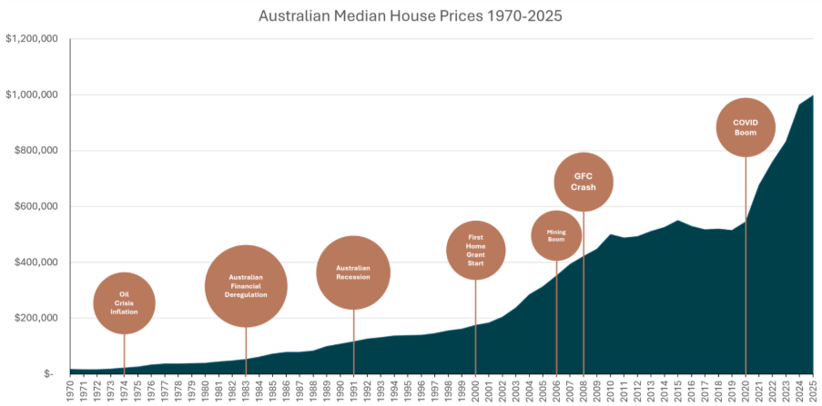
Waiting Has a Cost
Buyers often focus on the perceived risk of acting too early and ignore the very real financial cost of waiting. Waiting can mean:
This is particularly visible in the premium end of the market, where scarcity is real and buyers have learned that quality stock does not sit idle for long.
Who Is Asking the Question?
Different buyer groups ask the same question for different reasons, and the answer shifts according to goals, financing and timeframe.
Upgraders:
Upgraders often benefit from acting before competition heats up because they trade within the same cycle. If prices rise, both the property they own and the one they want tend to rise together. Waiting can widen the gap between the two and make the next step less attainable. Many upgraders also underestimate how scarce quality family homes are in established suburbs.
Investors:
Investors are more sensitive to rents, yields and future supply dynamics, all of which currently favour ownership. Rising rents and limited new builds have pushed gross yields higher in multiple capitals. Investors who delay can miss rental income, yield compression and depreciation benefits. For those with a long horizon, compounding and tax efficiency often outweigh the short term debate about entry timing.
Expats:
Expats face additional layers: currency windows, tax treatment and limited stock in premium suburbs. Many approach the market with an idealised price anchor from years prior and find that preferred suburbs have moved on. Delaying often means paying more in currency-adjusted terms and accepting compromised locations. For returning Australians, buying before re-entry allows choice rather than settling under time pressure.
First Home Buyers:
First home buyers must weigh affordability today against the probability that their preferred suburb moves further beyond reach. Rising rents can weaken savings, borrowing capacity and borrowing buffers. State incentives, stamp duty reforms and shared equity schemes can also shift the balance between acting now and waiting.
Downsizers:
Downsizers often benefit from planning early because the right property type is harder to find than assumed. Single level homes, boutique apartments, accessible locations and walkable amenities are all in short supply. Many downsizers take twelve to twenty four months to find the right fit and regret starting too late rather than too early. Selling first can also be advantageous in tight listing environments.
So Is Now a Good Time to Buy?
If you intend to hold for the long term, buy quality and secure a property that meets your needs, the answer has been remarkably consistent for decades: yes.
The best time to buy was yesterday.
The second best time is today.
The most common statements we hear from buyers over the years are not “I am glad I waited” but rather:
We rarely hear: “I am so relieved I avoided buying property in 2004.”
Final Thought
No one needs to pull out a crystal ball to make smart decisions. You simply need alignment between goals, time horizons, finance, location strategy and execution. Once those pieces are in place, the short term debate becomes background noise.
If you would like help shaping your plan for 2026, we are offering a limited number of February Buyer Strategy Sessions. These sessions are 20 minute complimentary strategy discussions with my team and designed to help you identify the right move for your situation.
Book a February Buyer Strategy Session now.
Wishing you every success in 2026.
Warm regards,
Rich Harvey
CEO & Founder
Propertybuyer
Give us a call on 1300 655 615 to start a conversation about your next property purchase, or click here to send us your enquiry today.
To have one of our friendly Buyers' Advocate's contact you, click here to:
 or
or
call us on 1300 655 615 today.



.svg)
.svg)
.svg)